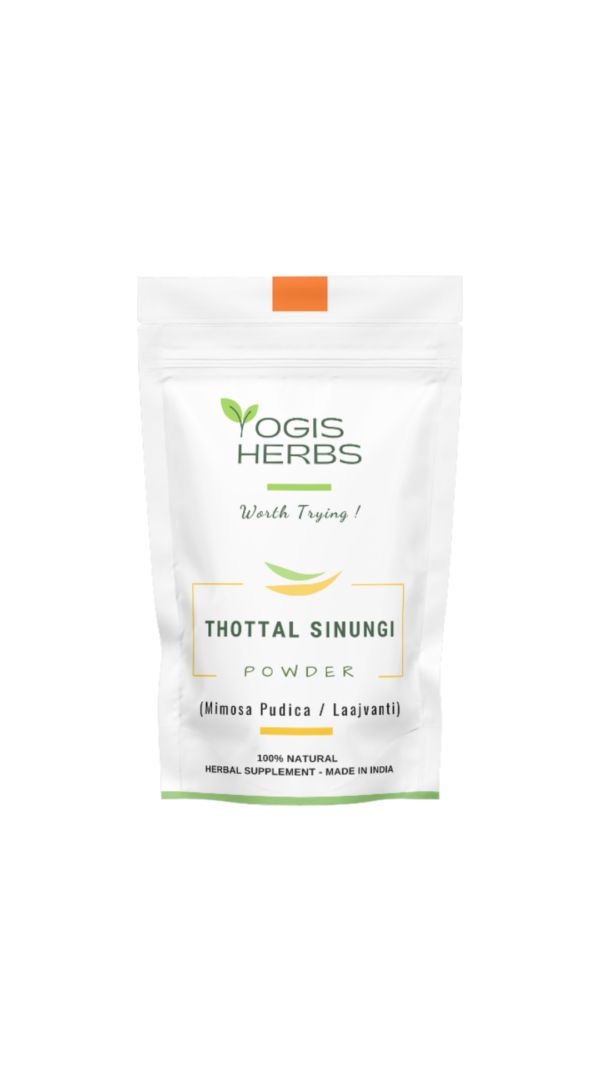








What is it
Some herbs you have to be told about. This one introduces itself. Brush a leaf of Thottal Sinungi and it folds — visibly, in a second or two — then quietly opens again a few minutes later. Tamil named it for exactly that: thottal sinungi, “touch it and it winces.” Sanskrit was more courteous: Lajjalu, “the bashful one,” and Namaskari, “the one that makes namaskaram” — the plant that bows when greeted. Ayurveda describes it in a single line: sparshaat sankochataam yaati punashcha prasruta bhavet — it draws itself in when touched, and spreads its leaves once more. Bitter and astringent in taste, cooling in nature, it has been used across Siddha and Ayurveda for centuries. We take the whole wildcrafted herb, cleaned and milled single-ingredient into a fine powder.
What Makes This Different
- Whole herb, single ingredient. One hundred percent Mimosa pudica — no fillers, no blends, no extract dilution.
- The whole plant, as tradition uses it. Siddha and Ayurveda work with the whole herb, and we say so — this is the plant, not the seed sold elsewhere for other purposes.
- Wildcrafted. Gathered where it grows on its own, along field edges and paths, as it always has been.
- Certified base: FSSAI Central Licensed, GMP compliant, ISO 22000.
What It Does
- A classical cooling, astringent herb. Ayurveda classes Lajjalu as bitter and astringent in taste (tikta, kashaya) and cooling in potency (sheeta) — a herb long valued for settling excess heat.
- Traditionally supportive of digestive comfort. Its astringent character has given it a long place in traditional approaches to comfortable, settled digestion.
- A traditional external application. For generations the powder has been made into a paste with water and applied to the skin and scalp — one of the most enduring folk uses of the herb.
- Naturally antioxidant-rich. Laboratory studies record antioxidant activity in the plant, tied to its flavonoids, tannins and phenolics (in vitro).
- Emerging angle — the plant that taught us about biological clocks. In 1729 the French astronomer de Mairan noticed that this plant’s daily leaf rhythm continued even in constant darkness — an observation now regarded as the first evidence of an internal biological clock. Three centuries on, Mimosa pudica remains a favourite subject in research on how plants sense, respond and even habituate.
Disclaimer
Yogis Herbs Thottal Sinungi Powder is a herbal food supplement, not a medicine, and is not intended to diagnose, treat, cure or prevent any disease. Best avoided during pregnancy and breastfeeding; children and anyone on medication should consult a healthcare professional before use. These statements have not been evaluated by the Food and Drug Administration. Individual results vary; enjoy as part of a balanced diet and healthy lifestyle.
References
- The Sensitive Plant Mimosa pudica: A Useful Medicinal Plant. IJSDR. Review. Records the Ayurvedic description of Lajjalu — sparshaat sankochataam yaati punashcha prasruta bhavet — and its classical properties: bitter and astringent taste (tikta, kashaya), cooling potency (sheeta), balancing Kapha and Pitta. https://www.ijsdr.org/papers/IJSDR1905055.pdf
- Phytochemistry and Medicinal Importance of Herb Mimosa pudica: A Review. Bentham Science. Review. Documents the plant’s thigmonastic movement and its phytochemistry — mimosine, flavonoids, sterols, terpenoids and tannins — alongside its recorded antioxidant activity. https://www.benthamscience.com/article/124579
- Mimosa pudica L. (Laajvanti): An Overview. Pharmacognosy Reviews. Review. Documents the plant’s regional names, its identification as Lajjalu in Ayurveda, and its constituents (mimosine, flavonoid C-glycosides, sterols, terpenoids, tannins, fatty acids). https://www.researchgate.net/publication/232232228
- The transcriptional mechanism behind Mimosa pudica leaf folding in response to mechanical disturbance (2025). PMC12500843. Plant science. Modern transcriptomic study of the leaf-folding response — evidence of how actively this plant is still being researched. https://www.ncbi.nlm.nih.gov/pmc/articles/PMC12500843/
- Comprehensive Review of Mimosa pudica. IJNRD (2025). Review. Records that the plant’s day-night leaf rhythm was first studied by Jean-Jacques d’Ortous de Mairan, and that the species remains a standard subject in research on plant habituation and memory. https://www.ijnrd.org/papers/IJNRD2511047.pdf