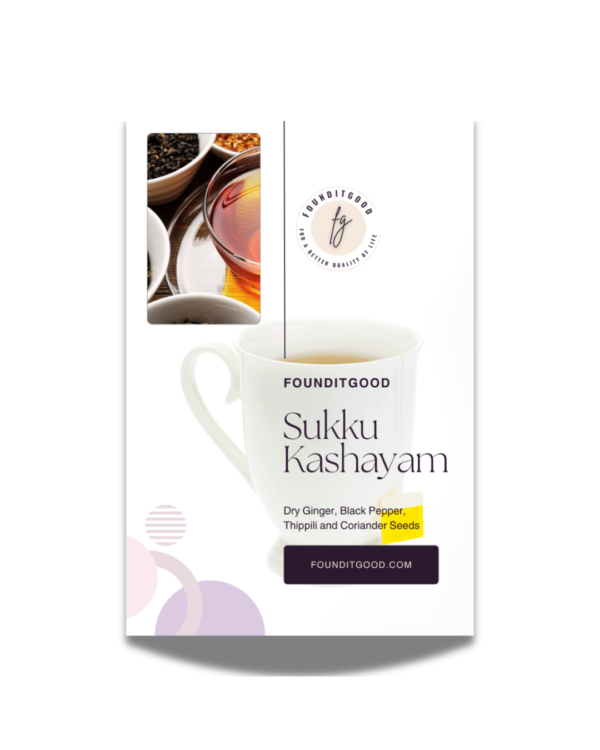
What Is It
Every South Indian household has a version of this cup. When the monsoon settles over the Western Ghats, after a heavy festival meal, or at the first scratch in the throat, a small vessel goes on the stove, dry ginger is crushed into water with a few peppercorns and seeds, and the kitchen fills with a sharp, sweet warmth. That cup is Sukku Kashayam: sukku is sun-dried ginger, and kashayam is the classical decoction, a preparation in which herbs are simmered rather than steeped so that their full character comes into the water.
At its centre is Sukku, which Ayurveda calls Shunthi and honours with two remarkable epithets in the Bhavaprakasha Nighantu: Vishvabheshaja, the universal remedy, and Mahaushadha, the great medicine. Ayurveda classifies it as Katu (pungent) in taste, Madhura (sweet) in post-digestive effect, and Ushna (warming) in potency, a combination prized because it warms without the harshness of fresh ginger. The Siddha Gunapadam places Sukku among the most frequently used herbs in the Tamil materia medica, and a Tamil saying holds that there is no remedy greater than dry ginger, as there is no god greater than Murugan.
Around it, our blend gathers the spices that South Indian kitchens and Siddha practitioners have paired with dry ginger for generations. Three of them, Sukku, Milagu and Thippili, together form Thirikadugu, known in Ayurveda as Trikatu, “the three pungents,” one of the oldest spice combinations in the classical texts.
Inside the blend: Sukku — Zingiber officinale (Dry Ginger) · Milagu — Piper nigrum (Black Pepper) · Val Milagu — Piper cubeba (Cubeb Pepper) · Thippili — Piper longum (Long Pepper) · Seeragam — Cuminum cyminum (Cumin Seeds) · Dhanya — Coriandrum sativum (Coriander Seeds) · Elakkai — Elettaria cardamomum (Cardamom) · Kirambu — Syzygium aromaticum (Clove) · Sombu — Foeniculum vulgare (Fennel Seeds) · Athimadhuram — Glycyrrhiza glabra (Liquorice Root)
What Makes This Different
A true kashayam, not a flavoured tea. Most “ginger teas” are fresh-ginger infusions or ginger-flavoured black tea. This is a decoction blend built in the classical manner: dry ginger at the centre, balanced by pungent, aromatic and sweet notes, and designed to be simmered. The dip bag simply removes the grinding and measuring.
Ten spices in considered proportion. The three peppers (black, cubeb and long) bring depth and heat. Cumin, coriander and fennel temper that heat with their cooling, aromatic character. Cardamom and clove lift the aroma, and Athimadhuram rounds the cup with a natural sweetness, so it needs no sugar.
Whole spices, coarsely cut. Each ingredient is cleaned, dried and cut to a coarse grade suited to decoction, so the aromatic oils stay in the spice until they meet the water.
Nothing added. No flavourings, no tea leaves, no sweeteners, no fillers. Naturally caffeine-free.
Made in Pollachi. Blended and packed at our facility at the foothills of the Western Ghats: FSSAI Central Licensed, GMP compliant and ISO 22000 certified, in operation since 2015.
What It Does
- A classical warming formula for the digestive fire. Ayurveda describes Shunthi and the Trikatu spices as Deepana and Pachana: herbs that kindle Agni, the digestive fire, and support the body’s own digestive process. Siddha practice uses Sukku for the same purpose, and this is the tradition in which a cup of sukku kashayam after a heavy meal belongs.
- Dry ginger and the rhythm of digestion. In a small randomised, double-blind human study of 24 healthy volunteers, ginger rhizome powder taken before a meal was associated with faster stomach emptying and more frequent stomach contractions compared with placebo. The study used encapsulated ginger rather than a decoction, but it offers a modern look at what the tradition has long described.
- Spices that work in company. Animal studies on traditional Indian spice combinations sharing several of this blend’s spices (black pepper, cumin, coriander and ginger) recorded higher activity of the body’s digestive enzymes and increased bile-acid output. These were rat studies using spice mixes that also included turmeric and chilli, so they point to the value of combining spices rather than describing this exact blend.
- Soothing comfort for the throat. Athimadhuram (liquorice root) is the Siddha and Ayurvedic herb of the throat and voice. Ayurveda calls it Kanthya, beneficial for the throat. In a small human trial, a simple preparation of liquorice root powder boiled in water and used as a gargle was associated with less throat discomfort among participants. That was a gargle in a clinical setting, not a tea, but it reflects the long traditional use of liquorice as a soothing root.
- A seasonal warming ritual. In Tamil homes, sukku kashayam is the cup of the rainy season and the cooler months: a warming, aromatic drink taken to feel comfortable and settled when the weather turns. Cardamom, clove and cubeb pepper add the aromatic, clearing quality that this seasonal use has always relied on.
- The emerging angle: why the peppers travel together. Ayurveda has long regarded the Trikatu spices as Yogavahi, carriers that help other herbs work better. Modern research has examined a related idea. In a study in rats and a small group of healthy human volunteers, piperine, the pungent compound of black and long pepper, markedly increased how much of turmeric’s curcumin reached the bloodstream. That study used isolated piperine, not whole pepper or a decoction, but it gives a contemporary dimension to one of Ayurveda’s oldest ideas about why spices are combined.
Sukku — The Universal Remedy, Simmered the Classical Way
The classical texts did not give Shunthi its names lightly. Vishvabheshaja means a remedy for all. Mahaushadha means the great medicine. In Tamil country, the regard is the same, carried in a saying every grandmother knows and every Siddha vaidyar repeats: there is no remedy beyond sukku. Drying transforms fresh ginger. It concentrates the pungency, deepens the warmth and changes the herb’s character in the Ayurvedic sense. The kashayam, simmered slowly with its companion spices, is how that transformed root has been taken for centuries.
The Western Ghats still grow these spices. We still blend them in Pollachi, in their shadow.
Summary of Benefits
- Supports comfortable digestion and the body’s natural digestive fire, in the classical Deepana–Pachana tradition
- Warming, aromatic comfort for the throat, with Athimadhuram (liquorice root), the traditional herb of the voice
- A seasonal wellness ritual for the rainy months and cooler weather
- Built on Thirikadugu (Trikatu), the three pungents of dry ginger, black pepper and long pepper
- Naturally sweet from liquorice root, with no added sugar, flavourings or fillers
- Caffeine-free, whole-spice decoction blend in convenient dip bags
How to Brew It
Traditional decoction method (recommended): Place one dip bag in 250 ml of cold or room-temperature water. Bring it slowly to the boil, then reduce the heat and simmer gently with the vessel covered for 5–7 minutes. Remove the bag, pour and enjoy warm. For a litre, use four dip bags. For a deeper, more concentrated traditional cup, simmer for up to 10 minutes, until the water has reduced slightly.
Infusion method (when simmering isn’t practical): Pour water at 95–100°C over one dip bag, cover, and infuse for 10–12 minutes. This produces a lighter cup, while the decoction develops greater body, depth and spice intensity.
Ways to enjoy it: Take it plain, warm and slowly. A small piece of palm jaggery (karupatti) is the traditional Tamil pairing, or add a little honey once the cup has cooled slightly. One to two cups a day suits most routines.
This is a warming, pungent blend. If you are pregnant or breastfeeding, taking medication, or considering it for a child, please speak with your healthcare practitioner first.
Disclaimer
Yogis Herbs Sukku Kashayam is a traditional herbal food product, intended as part of a balanced diet and not as a medicine. Pregnant or breastfeeding women, those taking prescription medication and anyone considering it for children should consult a qualified healthcare practitioner before use. These statements have not been evaluated by the Food and Drug Administration; this product is not intended to diagnose, treat, cure or prevent any disease.