What is it
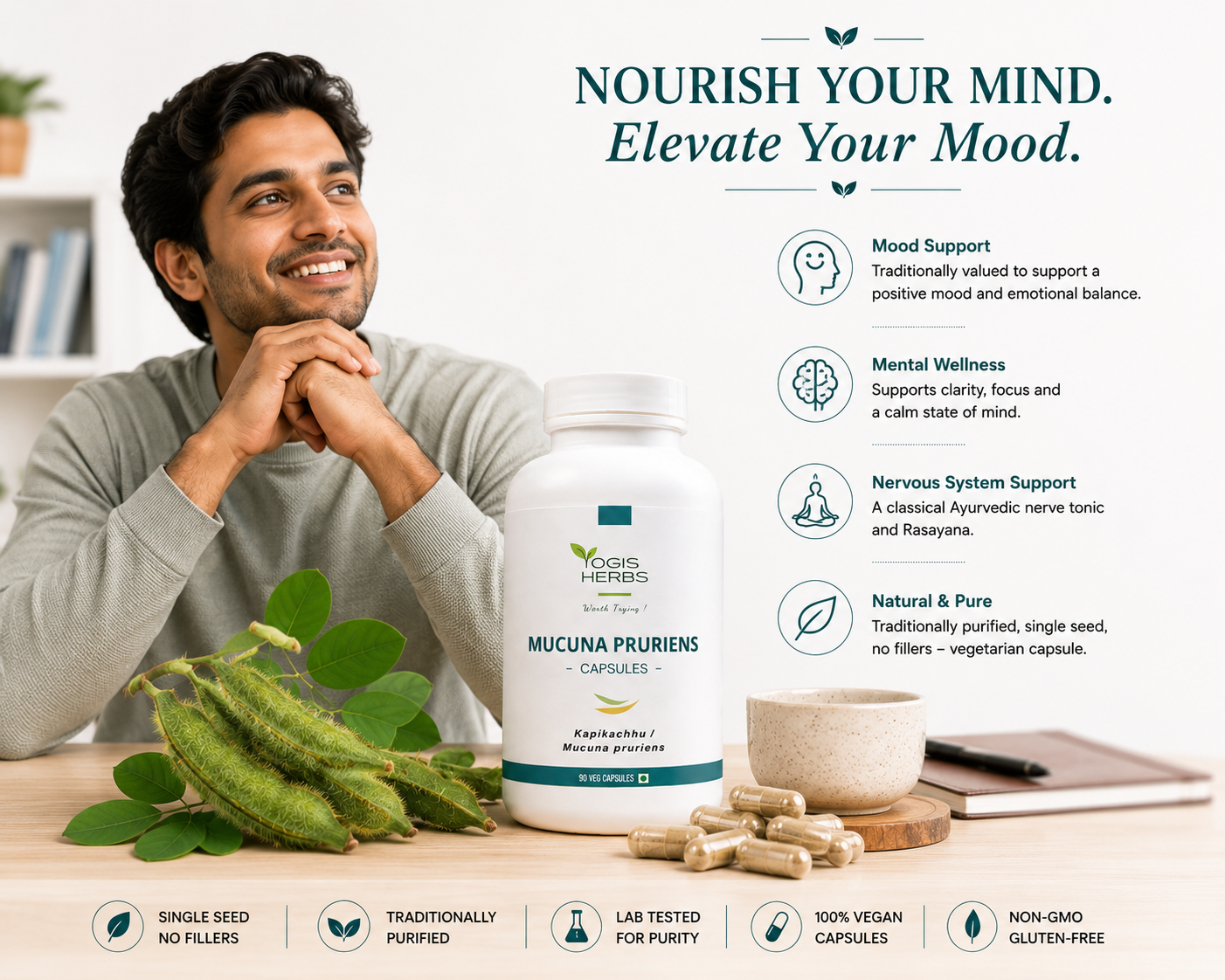
Kapikachhu — Poonaikkaali in Tamil, Mucuna pruriens to botanists — is the climbing velvet bean whose seed Ayurveda has prized for millennia as a Rasayana, a rejuvenative nerve tonic. Its Sanskrit names tell two truths at once: Kapikachhu, “the monkey’s itch,” for the fiercely irritating hairs that cloak its pods, and Atmagupta, “the self-guarded” — nature’s own way of protecting a precious seed. Classical practice never used the seed raw; it purified it first (shodhana) to tame the irritation and ready the seed for use. We honour that same principle with a careful, modern purification — the guarded treasure, safely unlocked.
What Makes This Different — It’s All About the Craft
Forget harsh, industrial processing. At Yogis Herbs we honour centuries of tradition, and our premium Mucuna seeds undergo a meticulous, time-tested preparation:
- Deeply purified. We begin with careful soaking and dehulling — not just cleaning, but a vital step that significantly reduces naturally occurring anti-nutrients and removes the irritating outer layer, for a purer, gentler seed.
- Gently prepared. Rather than aggressive processing, the seeds are then mildly roasted — gentle heat that preserves the seed’s precious natural L-DOPA and other beneficial compounds without degrading them.
- Ready for you. The purified seed is finely ground and encapsulated in high-quality vegetable-cellulose capsules — single-ingredient, no fillers or binders — perfect for a daily routine.
- Rooted in classical shodhana. This multi-step purification echoes the Ayurvedic tradition of preparing Kapikachhu before use: traditional care, modern safety, the full and authentic character of the seed in every capsule.
- Certified base: manufactured under strict FSSAI, GMP and ISO 22000 standards for quality, safety and purity.
What It Does
- The classical nerve tonic and Rasayana. For centuries Ayurveda has valued the Kapikachhu seed as a grounding, restorative nerve tonic — a Rasayana taken to steady and rejuvenate.
- Traditionally supportive of mood and mental wellness. Kapikachhu has long held a place in traditional approaches to a calm, positive and focused mind.
- Home to natural L-DOPA. The Mucuna seed is nature’s richest source of L-DOPA, the natural precursor the body uses to form dopamine — the reason this humble bean has drawn such lasting scientific interest.
- Studied for antioxidant activity in nerve-cell models. Laboratory research on the seed records antioxidant and anti-inflammatory activity in nerve-cell models (in vitro).
- Emerging angle — beyond L-DOPA. Researchers are increasingly interested in the seed’s other bioactives, which show antioxidant and nerve-supportive activity in the lab independent of its L-DOPA content (in vitro).
Atmagupta — The Guarded Treasure
The velvet bean does not give up its seed easily. Its pods are sheathed in fine hairs that sting and itch on contact — the reason Sanskrit called it Kapikachhu, “the monkey’s itch,” and Atmagupta, “the self-guarded.” Classical healers read this as nature protecting something valuable, and answered it with shodhana: patient purification that tamed the seed and released its worth. Our purified capsules are that old wisdom, carried forward — the treasure, unguarded and ready.
How to Take It
Take one veg capsule twice daily with water, after food, or as directed by a healthcare professional. Best taken steadily as part of a daily routine. Because Mucuna is a naturally active seed, it is especially important that anyone who is pregnant or breastfeeding, giving it to a child, or taking prescription medication — including medication for mood, blood pressure or the nervous system — consult a healthcare professional before use.
Disclaimer
Yogis Herbs Purified Mucuna Pruriens Capsules are a herbal food supplement, not a medicine, and are not intended to diagnose, treat, cure or prevent any disease. Those who are pregnant or breastfeeding, children, and anyone on medication should consult a healthcare professional before use. These statements have not been evaluated by the Food and Drug Administration. Individual results vary; enjoy as part of a balanced diet and healthy lifestyle.
References
- Kamkaen N. et al. (2022). Mucuna pruriens Seed Aqueous Extract Improved Neuroprotective and Acetylcholinesterase Inhibitory Effects Compared with Synthetic L-Dopa. Molecules, 27(10):3131. PMC9145663. In vitro (seed). HPLC quantified the seed’s L-DOPA, and the seed extract showed neuroprotective and antioxidant activity in nerve-cell models. https://www.ncbi.nlm.nih.gov/pmc/articles/PMC9145663/
- Levodopa-Reduced Mucuna pruriens Seed Extract Shows Neuroprotective Effects… (2018). PMC6164394. In vitro (seed). Even with L-DOPA reduced below 0.1%, the seed extract lowered oxidative stress and inflammatory markers in nerve-cell models — evidence of antioxidant activity from its non-L-DOPA compounds. https://www.ncbi.nlm.nih.gov/pmc/articles/PMC6164394/
- Kapikachhu (Mucuna pruriens) — A Review (2025). IJPREMS. Review (seed). Documents the seed as an exceptionally rich natural source of L-DOPA (approx. 4-7% of dry weight), alongside antioxidant and anti-inflammatory constituents. https://www.ijprems.com/uploadedfiles/paper//issue_10_october_2025/44128/final/fin_ijprems1760075148.pdf
- Rai S.N. et al. (2022). Neuroprotection by Mucuna pruriens in Neurodegenerative Diseases. Neurochemical Research. Review. Reviews the seed’s documented antioxidant and anti-inflammatory properties within Ayurvedic tradition. https://link.springer.com/article/10.1007/s11064-022-03591-3