What is it
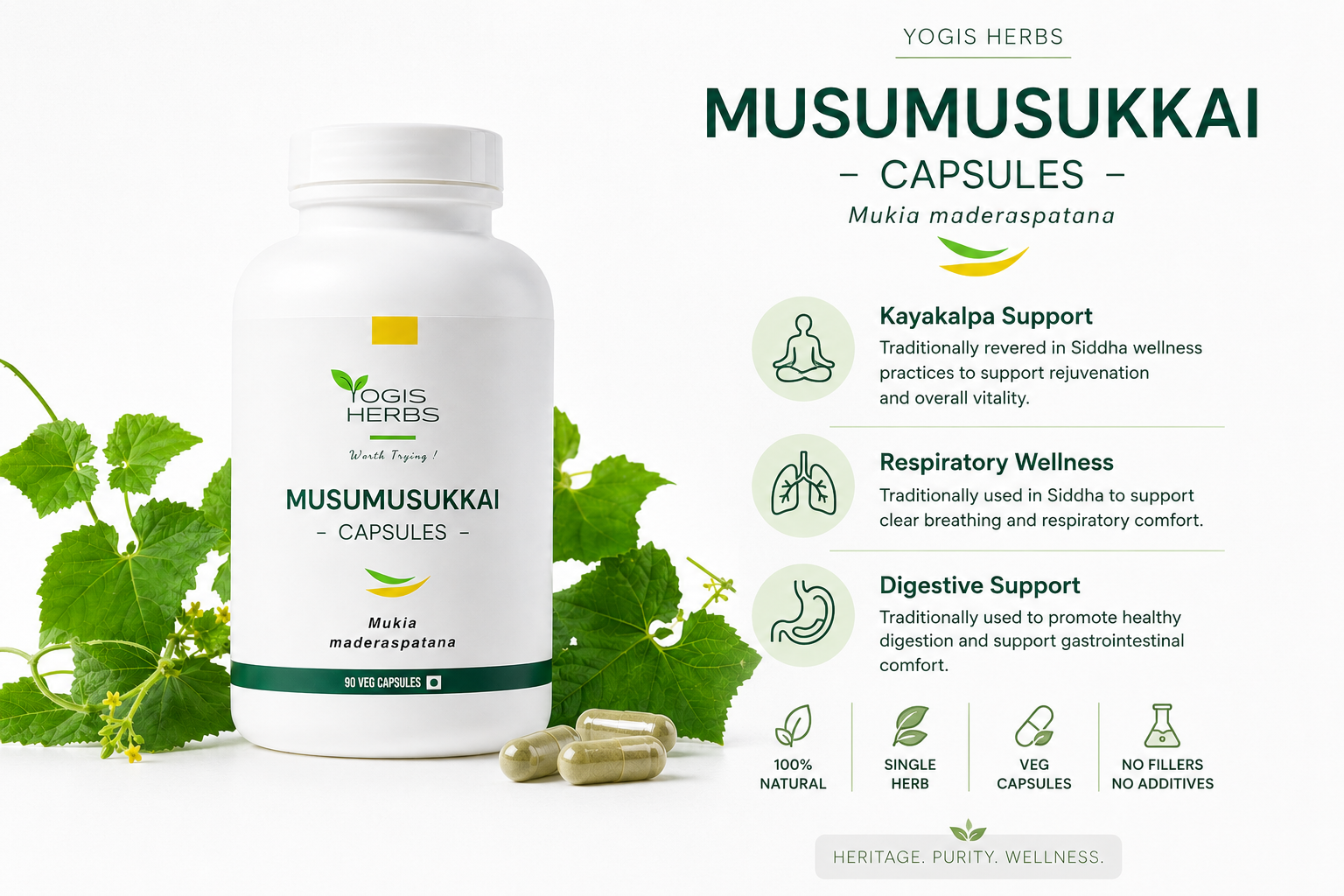
Musumusukkai — Mukia maderaspatana, the little hairy creeper of the South Indian roadside — is one of the most everyday of all Tamil greens. Its name is pure Tamil onomatopoeia: musu musu, for the soft, fuzzy roughness of its leaves and tiny fruits. A humble vine sold by vegetable vendors across the South, it has been woven into Siddha medicine for some two thousand years — recorded in classical Siddha texts — and into the home kitchen, where its leaves are cooked into thuvaiyal and rasam, especially through the damp, cough-prone months. We take the whole herb, cleaned and milled single-ingredient into a vegetarian capsule — the everyday monsoon green, made effortless.
What Makes This Different
- Whole herb, single ingredient. One hundred percent Mukia maderaspatana powder — no fillers, binders, flow agents or extract dilution. No additives.
- The whole plant, as tradition uses it. Siddha and the Tamil kitchen use the whole green; we use the whole herb, and say so.
- The monsoon thuvaiyal, made simple. Musumusukkai is a leaf you’d cook fresh into a cough-season chutney; the capsule delivers the clean herb, ready.
- Certified base: FSSAI Central Licensed, GMP compliant, ISO 22000.
What It Does
- A traditional monsoon green for the breath. For two thousand years Siddha and the Tamil kitchen have turned to Musumusukkai for clear, comfortable breathing — especially through the damp, changing seasons.
- Traditionally supportive of digestive comfort. Long valued as a carminative kitchen green, Musumusukkai has featured in traditional approaches to comfortable digestion and a healthy appetite.
- Naturally antioxidant-rich. Laboratory studies of the leaf record antioxidant activity, tied to its flavonoids, phenolics and beta-sitosterol (in vitro).
- A nourishing everyday food green. More food than medicine in the Tamil home, Musumusukkai is eaten as thuvaiyal, rasam and poriyal — a green woven into daily nourishment.
- Emerging angle — its phytochemistry. Musumusukkai’s phenolics and plant sterols (including beta-sitosterol) are an active area of antioxidant research (in vitro).
Musumusukkai — Named for the Way It Feels
Some herbs are named for a god, some for a place; this one is named for its texture. Musu musu — the soft, fuzzy roughness of the little creeper’s leaves and fruit, a word that is really just the feeling of touching it. No grand Sanskrit title, no temple legend: just a humble roadside vine that Tamil households have cooked into cough-season thuvaiyal for two thousand years, and Siddha healers recorded long before that. The most ordinary of greens — and, precisely because of that, one of the most trusted.
How to Take It
Take one veg capsule twice daily with water, after food, or as directed by a healthcare professional. In keeping with tradition, Musumusukkai is enjoyed as an everyday green, especially through damp and changing seasons. Best taken steadily as part of a balanced routine. If you are pregnant or breastfeeding, giving it to a child, or taking prescription medication, consult a healthcare professional before use.
Disclaimer
Yogis Herbs Musumusukkai Capsules are a herbal food supplement, not a medicine, and are not intended to diagnose, treat, cure or prevent any disease. Those who are pregnant or breastfeeding, children, and anyone on medication should consult a healthcare professional before use. These statements have not been evaluated by the Food and Drug Administration. Individual results vary; enjoy as part of a balanced diet and healthy lifestyle.
References
- Ethnobotanical and pharmacological profile of Mukia maderaspatana (L.) M. Roem. Indian Journal of Natural Products and Resources. Review. Documents the plant’s Siddha use (recorded in Yogaratnagaram and Sahasrayaham), its Tamil and Sanskrit names, its status as a functional-food green, and the antioxidant constitution of its leaves. https://nopr.niscpr.res.in/bitstream/123456789/17433/1/IJNPR%204(1)%209-26.pdf
- Evaluation of Nutrient Composition and Phytochemical Potential of Leaf and Stem of Mukia maderaspatana (2013). In vitro (leaf/stem). Phytochemical screening found glycosides, flavonoids, phenols, alkaloids and saponins; the leaf was higher in protein than in lipid or carbohydrate. https://www.researchgate.net/publication/254582136
- Pharmacological Activities of Mukia maderaspatana (L.): A Review (2023). International Journal of Science and Research. Review. Documents the whole plant’s phytochemistry (including beta-sitosterol) and its antioxidant and anti-inflammatory activity in laboratory studies. https://www.ijsr.net/archive/v12i6/SR23607000832.pdf
- A review on pharmacological activities of Mukia maderaspatana (2022). International Journal of Health Sciences. Review. Documents the plant’s long traditional use as a cough-and-cold green and its phenolic phytochemistry. https://sciencescholar.us/journal/index.php/ijhs/article/view/6826