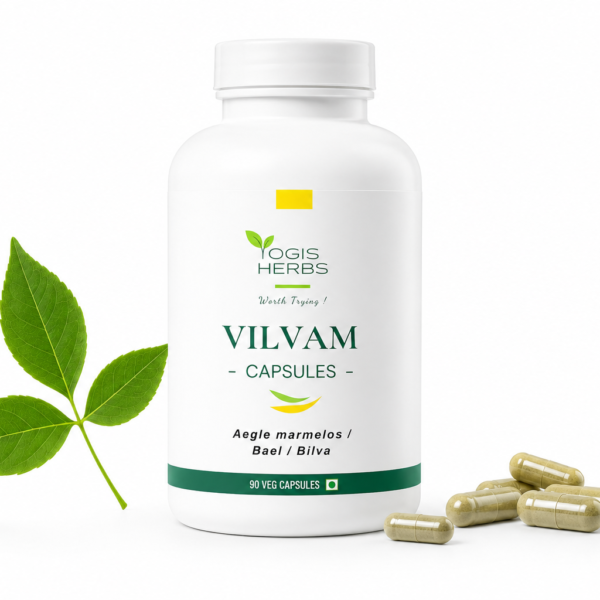
What is it
Sirukurinjan — Gymnema sylvestre, the woody forest climber of central and southern India — is one of the most singularly named herbs in the world. Sanskrit called it Madhunashini, “the destroyer of sweetness,” and Meshashringi, “ram’s horn,” for its curved, horn-shaped follicles; Hindi calls it Gurmar, “sugar killer”; Malayalam, Chakkarakolli, the same. Four languages, one strange and specific reputation. Ayurveda’s Bhava Prakasha recorded it centuries ago, among the herbs of metabolic wellness. We take the whole leaf, cleaned and milled single-ingredient into a vegetarian capsule.
What Makes This Different
- Whole leaf, single ingredient. One hundred percent Gymnema sylvestre leaf powder — no fillers, binders, flow agents or extract dilution. No additives.
- The leaf, the part tradition uses. Sirukurinjan’s reputation rests on the leaf; we use the leaf, and say so.
- The bitter forest leaf, made simple. Chewed fresh, the leaf is intensely bitter; the capsule delivers it clean, ready.
- Certified base: FSSAI Central Licensed, GMP compliant, ISO 22000.
What It Does
- A herb named “the sugar destroyer.” Across four Indian languages, Sirukurinjan carries the same name — Madhunashini, Gurmar, Chakkarakolli, “the destroyer of sweetness” — earned from a genuine and peculiar property: chew the fresh leaf, and for a while afterwards, sugar tastes of almost nothing.
- The taste science behind the name. Modern research has identified why: the leaf’s gymnemic acids bind briefly to the sweet-taste receptors on the tongue, selectively muting the perception of sweetness — while leaving salty, sour and bitter untouched — before wearing off within minutes (human sensory studies).
- A traditional metabolic-wellness herb. In Ayurveda and Siddha, Sirukurinjan has long held a place in traditional approaches to everyday metabolic balance.
- Traditionally supportive of digestion. Bitter and astringent by nature, the leaf has featured in traditional approaches to comfortable digestion.
- Naturally antioxidant-rich. Laboratory studies record antioxidant activity in the leaf extract (in vitro).

Madhunashini — The Destroyer of Sweetness
It is rare for a plant to be named, in four languages, for a single strange gift. Sanskrit called it Madhunashini, “destroyer of sweetness”; Hindi, Gurmar, “sugar killer”; Malayalam, Chakkarakolli, the same again. The reason is real and easily proven: chew a leaf of Sirukurinjan, then taste something sweet, and the sweetness has simply vanished — sugar tastes of water — for a quarter of an hour, before returning as if nothing had happened. A forest climber that, for a few minutes, edits one flavour out of the world. Ayurveda’s Bhava Prakasha noted it long before anyone found the receptor it works upon.
How to Take It
Take one veg capsule twice daily with water, after food, or as directed by a healthcare professional. Best taken steadily as part of a balanced routine. Because Sirukurinjan is a traditionally active herb, it is especially important that anyone who is pregnant or breastfeeding, giving it to a child, or taking prescription medication consult a healthcare professional before use.
Disclaimer
Yogis Herbs Sirukurinjan Capsules are a herbal food supplement, not a medicine, and are not intended to diagnose, treat, cure or prevent any disease. Those who are pregnant or breastfeeding, children, and anyone on medication should consult a healthcare professional before use. These statements have not been evaluated by the Food and Drug Administration. Individual results vary; enjoy as part of a balanced diet and healthy lifestyle.
References
- Phytochemical and Pharmacological Properties of Gymnema sylvestre: An Important Medicinal Plant. PMC3912882. Review. Documents the leaf’s gymnemic acids and the peptide gurmarin, their selective suppression of sweet taste, and the plant’s antioxidant activity. https://pmc.ncbi.nlm.nih.gov/articles/PMC3912882/
- Consuming Gymnema sylvestre… selective suppression of sweet taste (2020). PMC7230589. Human (sensory). Gymnemic acids selectively suppress the tongue’s taste response to sweet compounds – via the T1R2/T1R3 sweet receptors – without affecting salty, sour, bitter or umami; the effect is temporary and reversible. https://www.ncbi.nlm.nih.gov/pmc/articles/PMC7230589/
- Gymnema sylvestre: A Memoir. PMC2170951. Review. Records the classical names Meshashringi (“ram’s horn”) and Madhunashini (“destroyer of sweetness”) and the sweet-taste-blocking action of gymnemic acid and gurmarin. https://pmc.ncbi.nlm.nih.gov/articles/PMC2170951/
- Bhava Prakasha Nighantu, Guduchyadi Varga, shloka 253-254. Classical text. The classical Ayurvedic materia medica records Meshashringi (Gymnema sylvestre) among its herbs.